

➡️ KEY TAKEAWAYS
- Artificial intelligence or AI is a computer’s ability to perform tasks that normally require human intelligence – understanding language, recognizing patterns, and making decisions.
- AI is an umbrella term: machine learning, deep learning, NLP (Natural Language Processing), and generative AI are all subfields under it.
- The AI market is valued at around ~$244–390B in 2025 and projected to exceed $827B by 2030 (PwC forecasts a $15.7T economic contribution by 2030).
- All AI today is “narrow AI” – highly capable at specific tasks but incapable of general human -level reasoning.
- The most important AI development right now is the shift to agentic AI: systems that can plan, take actions, and complete long-horizon tasks autonomously.
Artificial intelligence is no longer a technology of the future – it’s the infrastructure of the present.
Here’s everything you need to understand what AI actually is, how it works, and why it matters in 2026 and beyond.
What is artificial intelligence?
Artificial intelligence (AI) is the ability of a machine or computer system to perform tasks that typically require human intelligence. This includes understanding language, recognizing images, making decisions, solving problems, and learning from experience.
It is not one technology but a broad field encompassing dozens of subfields, techniques, and applications.
A useful working definition comes from Stanford University’s Emerging Technology Review:
“AI is the ability of computers to perform functions associated with the human brain, including perceiving, reasoning, learning, interacting, problem solving, and exercising creativity.”
The simplest way to understand AI is through contrast.
Traditional software follows explicit rules: if X, do Y. AI systems, by contrast, learn patterns from data and use those patterns to handle situations they’ve never seen before.
That shift – from following the rules to learning the patterns – is the conceptual leap that made modern AI possible.
Here’s a💡 plain-English definition:
AI is software that learns from examples rather than rules. Instead of a programmer writing out every possible scenario, an AI system is trained on large amounts of data and figures out its own internal logic for handling new situations.
A very brief history of AI
AI wasn’t born overnight – it’s the product of nearly 80 years of research, false starts, breakthroughs, and funding winters.
Understanding the timeline helps explain why the current moment feels different.
A Brief History of AI
1950
1956
1970s to 80s
1997
2012
2017
2022 to 23
2024 to 25
How AI actually works
At its core, modern AI works through a process called training.
A model is exposed to enormous amounts of data – text, images, code, audio – and adjusts millions (or billions) of internal numerical parameters to get better at predicting patterns within that data.
In short, Data is fed into a model > the model finds numeric parameters > trains on the parameters > makes prediction based on the learned patterns.
Once trained, the model can apply those learned patterns to new inputs it’s never encountered.
Here’s a simplified view of how a modern AI model is built and used:
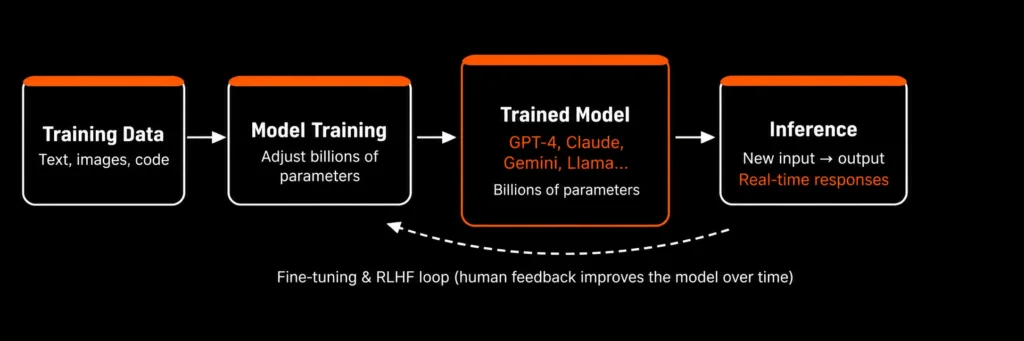
The key step that made AI dramatically more useful is a technique called Reinforcement Learning from Human Feedback (RLHF), used in models like ChatGPT and Claude.
After initial training, human raters evaluate the model’s outputs and provide rankings.
The model then adjusts to produce outputs humans prefer – which is why modern AI feels much more natural and helpful than older systems.
For a deeper technical breakdown, see Stanford HAI’s 2025 AI Index Report, which provides a comprehensive, data-driven overview of AI progress across every dimension.
The subfields of AI explained
AI is not a single technology. It’s a family of related approaches.
The diagram below shows how the major subfields nest inside each other:
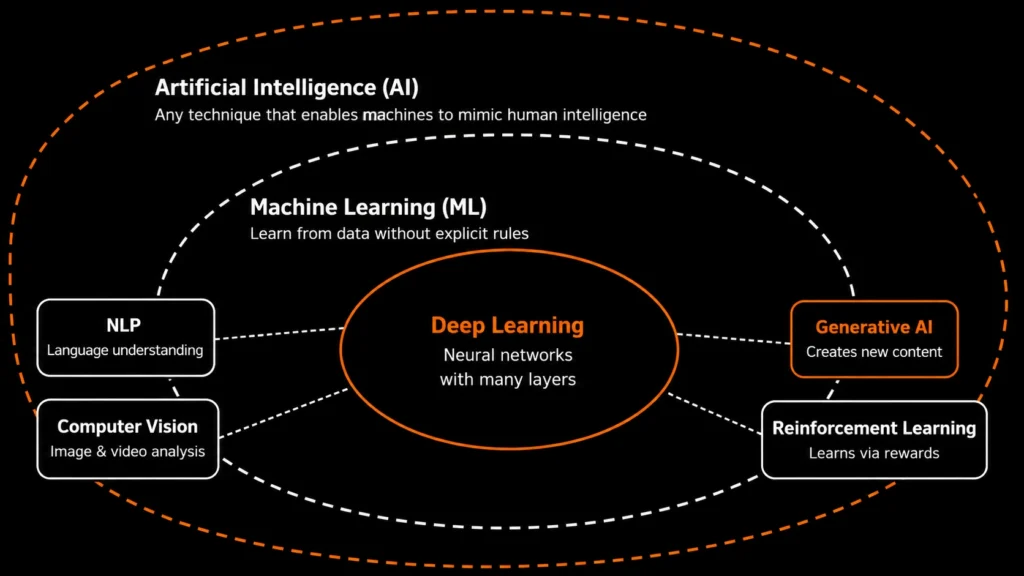
Here’s a breakdown of the subfields:
👉 Machine Learning (ML)
Machine learning is the engine under most modern AI.
Instead of hand-coding rules, you feed a system large amounts of labeled data and let it figure out the underlying patterns.
For example, an ML model trained on thousands of emails labelled “spam” and “not spam” learns to distinguish between them – without anyone explicitly defining what spam looks like.
👉 Deep Learning (DL)
Deep learning is ML using artificial neural networks inspired by the human brain.
These networks have many layers (“deep” refers to depth of layers) that process information at increasing levels of abstraction.
Examples for deep learning include face recognition, real-time translation, voice assistants, and large language models.
It requires enormous compute and data – which is why deep learning only became practical after GPU-powered cloud computing made scale affordable.
👉 Natural Language Processing (NLP)
NLP is the subfield concerned with enabling machines to understand and generate human language.
Every time you interact with ChatGPT, ask Siri a question, or use Google Translate, you’re using NLP.
Modern NLP is dominated by Transformer-based models, introduced by Google in 2017.
👉 Computer Vision
Computer vision gives machines the ability to interpret visual information – images, video, medical scans, satellite imagery.
It powers everything from iPhone Face ID to cancer detection systems to Tesla Autopilot.
Deep learning transformed the field: in 2012, AlexNet cut the image classification error rate nearly in half overnight.
👉 Generative AI (GenAI)
Generative AI refers to systems that can produce new content – text, images, code, audio, video – rather than simply classifying existing content.
ChatGPT, Claude, Midjourney, Sora, and GitHub Copilot are all generative AI systems.
This is the category that triggered the current mainstream AI moment, and it’s growing faster than any previous AI subfield.
So, in summary:
- AI = The ultimate goal
- Machine Learning = The means to reach the goal
- Deep Learning = The best technique to reach the goal
- NLP and Computer Vision = The applications
- Generative AI = The modern frontier in existence
Types of AI: Narrow, General, and Super
Beyond subfields, AI is also categorized by capability – specifically, by how general its intelligence is.
This distinction matters because it defines both what today’s AI can do and what the long-term risks and opportunities actually are.
| Type | Also called | What it can do | Status | Examples |
|---|---|---|---|---|
| Narrow AI | ANI / Weak AI | One specific domain or task | Exists today | ChatGPT, AlphaGo, Siri, recommendation engines |
| General AI | AGI / Strong AI | Any intellectual task a human can do | Not yet achieved | No confirmed examples — under active research |
| Superintelligent AI | ASI | Surpasses human intelligence in all domains | Theoretical | Sci-fi concept; no technical roadmap currently exists |
An important point for cutting through media hype: all AI that exists today is Narrow AI. GPT-4, Claude, and Gemini are extraordinarily capable within the domains they’ve been trained on – but they cannot reason across entirely new domains the way humans can, they don’t have persistent goals, and they don’t “want” anything.
The idea that AI systems secretly have motivations or feelings is a projection, not a technical reality (as of 2025).
That said, the boundary of “narrow” is expanding rapidly.
As AI systems gain memory, tool use, and the ability to orchestrate other AI agents – capabilities that define the current “agentic AI” moment – the practical gap between narrow AI and general AI narrows in ways that matter enormously for business, policy, and society.
Real-world applications of AI in 2026
AI has moved from the lab to the infrastructure layer of virtually every major industry. Here are the most consequential applications active today:
Healthcare
Medical image analysis, drug discovery, clinical note summarization, early disease detection. AI systems now flag cancers in radiology scans with accuracy matching or exceeding specialists.
Software Engineering
AI-generated code is estimated to account for roughly 30% of code at companies like Microsoft and Google in 2026. Tools like GitHub Copilot and Claude Code accelerate development across the stack.
Banking and Finance
Fraud detection, algorithmic trading, risk modeling, customer service automation. BFSI is the largest end-use segment of the global AI market.
Education
Personalized tutoring, automated grading, curriculum design, accessibility tools for students with disabilities. AI tutors can adapt explanations in real-time to individual learning styles.
Manufacturing
Predictive maintenance, quality control via computer vision, supply chain optimization, and robotic automation that adapts to new tasks without re-programming.
Environmental Impact
Climate modeling, precision agriculture, energy grid optimization, and carbon footprint analytics. AI is now a core tool for environmental sustainability research and policy.
E-commerce
Recommendation engines, dynamic pricing, demand forecasting, and personalized marketing. Netflix estimates its recommendation system drives ~$1B/year in retained subscriptions.
Legal and Compliance
Lorem ipsum dolor sit amet, consectetur adipiscing elit. Aenean diam dolor, accumsan sed rutrum vel, dapibus et leo.
The AI market: scale, investment, and growth
Understanding the scale of the AI market helps contextualize why every major company, government, and investor is repositioning around it.
The numbers are not incremental – they represent one of the most significant economic shifts in modern history.
$244B
Global AI market size in 2025 (Statista software estimate)
$827B
Projected AI market size by 2030 at ~28% CAGR
$15.7T
PwC’s global GDP Contribution by 2030
$202B
Venture capital invested in AI in 2025 – ~50% of all global Venture Capital
77%
Companies using or actively testing AI tools in 2025-2026 and beyond
42%
Large corporations with AI fully deployed in operations (IBM 2025)
⚠️ A Note on Market Size Figures
Different research methodologies produce very different AI market estimates – you’ll see figures ranging from $244B to $757B for 2025.
The differences come from scope: some include only software, others include hardware, services, and adjacent markets.
What every credible source agrees on is the direction and magnitude of growth – extraordinary, and accelerating.
Risks, limitations, and ethics
Any honest guide to AI has to reckon with the downsides.
The risks of AI are real, diverse, and operate on different timescales – from immediate practical concerns to longer-term structural challenges.
Near-term risks (here now)
Bias and fairness:
AI systems learn from historical data, which often encodes historical inequities. A hiring algorithm trained on past hires may systematically disadvantage certain groups.
A facial recognition system trained on non-diverse data may fail disproportionately for darker-skinned individuals.
These aren’t hypothetical – they’ve been documented in production systems at major institutions.
Misinformation at scale:
Generative AI makes it cheaper to produce convincing false content – text, images, audio, and video – than at any prior point in history.
The implications for elections, journalism, and public trust are significant and still unfolding.
Job displacement:
UNCTAD estimates AI could affect 40% of jobs globally, with up to one-third of roles in advanced economies at risk of automation.
The transition challenge – retraining workers, managing sector disruption – is real even if the net long-term economic effect is positive.
Hallucinations:
Current large language models are not truth engines – they’re prediction engines.
They generate plausible-sounding text, which sometimes happens to be factually wrong.
Deploying AI in high-stakes domains (medicine, law, finance) without human oversight is a genuine risk.
Medium-term concerns
Concentration of power:
AI development is extremely capital-intensive, concentrating meaningful capability in a handful of companies and nations.
In 2022, just 100 companies – mainly in the US and China – accounted for 40% of global AI R&D.
The geopolitical implications of that concentration are significant.
Privacy and surveillance:
AI dramatically lowers the cost of surveillance – face recognition at scale, behavioral profiling, voice analysis.
Governance frameworks for these uses are lagging behind technical capability in most jurisdictions.
Long-term risks (under debate)
The risks associated with hypothetical AGI or superintelligent AI – systems that could pursue goals misaligned with human values – are taken seriously by a significant subset of AI researchers, including at leading labs.
These risks are not imminent, but the difficulty of “correcting” a sufficiently capable misaligned system is a legitimate research concern that motivates work in AI safety and alignment.
🔍 Further Reading on AI Ethics
For rigorous, balanced treatment of AI risks and governance:
- Stanford HAI’s 2025 AI Index
- UNCTAD Technology and Innovation Report 2025 ·
- The European Union’s AI Act (in force August 2024) — the world’s most comprehensive AI regulation.
What comes next: Agents, multimodality, and the infrastructure shift
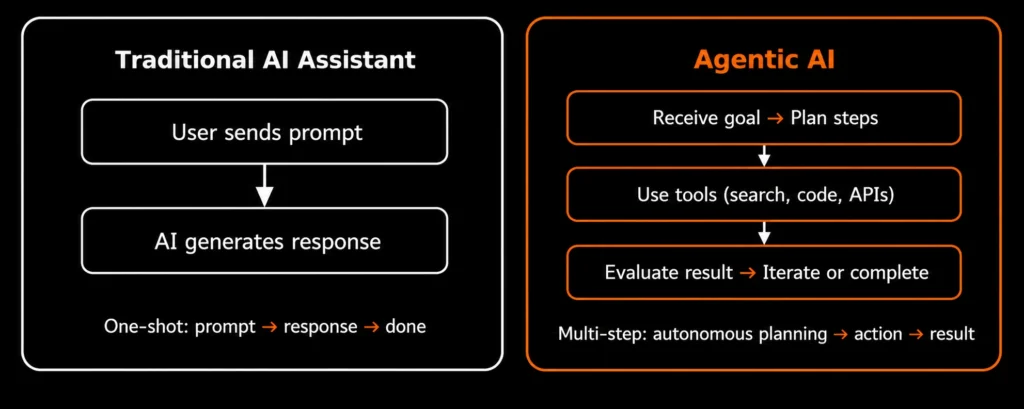
The most important AI development of 2024-2025 isn’t a new model. It’s a new mode of operation: agentic AI.
Earlier AI systems responded to prompts. They were reactive.
Agentic AI systems are proactive – they can set sub-goals, use tools (web search, code execution, APIs, file systems), take actions in the world, and work toward long-horizon objectives with minimal moment-to-moment human input.
An AI agent today can be given the objective “research competitor pricing, draft a report, and update our internal database” — and complete it without further prompting.
Beyond agency, three other trends are defining the near-term AI landscape:
➡️ Multimodality
The latest models process text, images, audio, and video simultaneously.
A model like GPT-4o or Gemini Ultra can watch a video, listen to speech, and generate a written analysis – all in one pass.
This makes AI radically more useful in real-world, mixed-media contexts.
➡️ Smaller, faster, cheaper models
The compute-efficiency frontier is advancing rapidly.
Models that required data-center infrastructure two years ago now run on a laptop or smartphone.
This “edge AI” trend democratizes capability and enables applications where latency or privacy make cloud-based AI impractical.
➡️ AI-to-AI coordination
Multi-agent systems – where networks of AI agents collaborate, check each other’s work, and specialize in subtasks – are emerging as a new architectural paradigm.
This is explored in depth in our guide to multi-agent AI systems.
🔭 Where This Is All Heading
By 2028, Gartner predicts that 33% of enterprise software will include agentic AI and 15% of day-to-day work decisions will be made autonomously. The shift is from AI as a tool you use to AI as a colleague you manage.
What is artificial intelligence in simple terms?
Artificial intelligence (AI) is the ability of a computer or machine to perform tasks that normally require human intelligence – such as understanding language, recognizing images, making decisions, and learning from experience.
What is the difference between AI, machine learning, and deep learning?
AI is the broadest term – any machine that mimics human intelligence. Machine learning (ML) is a subset: systems that learn from data without being explicitly programmed.
Deep learning is a subset of ML that uses multi-layered artificial neural networks. Think of it as nesting dolls: Deep Learning > Machine Learning > AI.
Is AI the same as a robot?
No. AI is software – the “intelligence” component. A robot is a physical machine.
Some robots use AI to make decisions, but most AI systems (like ChatGPT, Gemini, Claude, or a fraud detection model) have no physical body at all.
And most robots use very simple logic, not AI. They are related but separate concepts.
What is Generative AI (Gen AI)?
Generative AI refers to AI systems that create new content – text, images, code, audio, video – based on patterns learned from training data.
Examples include ChatGPT (text), Midjourney (images), GitHub Copilot (code), Sora (video), and ElevenLabs (voice).
It’s distinct from “discriminative” AI, which classifies or analyzes existing content rather than creating new content.
What is the size of the global AI market?
The global AI market is valued at approximately $244 to 390 billion in 2025, depending on methodology.
It is projected to exceed $827 billion by 2030, growing at roughly 27 to 30% annually.
PwC projects AI will contribute up to $15.7 trillion to global GDP by 2030 – more than the combined current output of China and India.
Is AI dangerous?
Current AI systems carry real but manageable risks – bias, misinformation, job displacement, privacy erosion, and misuse by bad actors.
These risks are being actively studied and governed.
The more speculative risk of a superintelligent AI pursuing goals harmful to humanity remains theoretical; it motivates AI safety research but is not an imminent threat.
As with all powerful technologies, the question isn’t “safe or dangerous?” but “how do we govern it responsibly?”
Do I need to know how to code to use AI?
No. Most AI tools today – ChatGPT, Claude, Gemini, Midjourney, Copilot – require no coding knowledge whatsoever.
You interact with them in plain language. Coding becomes relevant if you want to build AI-powered applications, integrate AI into existing software, or customize models for specific use cases.
But using AI productively as a professional or individual doesn’t require any technical background.
